Showing posts with label Tidbits and Pearls. Show all posts

Thursday, November 4, 2021

Precious Pearls - Quotes That Have Inspired Me (#6)

Our teacher, Guy Finley, challenged us last night to do a simple exercise each morning. Find a quote, something that touches us, and spend time exploring it. He said, "Something greater always sits behind - sits within - all wisdom...in all that is beautiful. So, there is no end to what you can discover. Go explore."

And so I'm moved to return here to do just that. Here is the Pearl I'll ponder this morning.

"May I never miss a sunset or a rainbow because I am looking down." (Sara June Parker)

We have had another beautiful fall here in southern Oregon. Deborah and I have walked through cathedrals of trees, divinely aglow in their red and yellow vestments. We've sat captivated, watching troupes of leaves dancing and spinning joyfully as the breezes sent them flying.


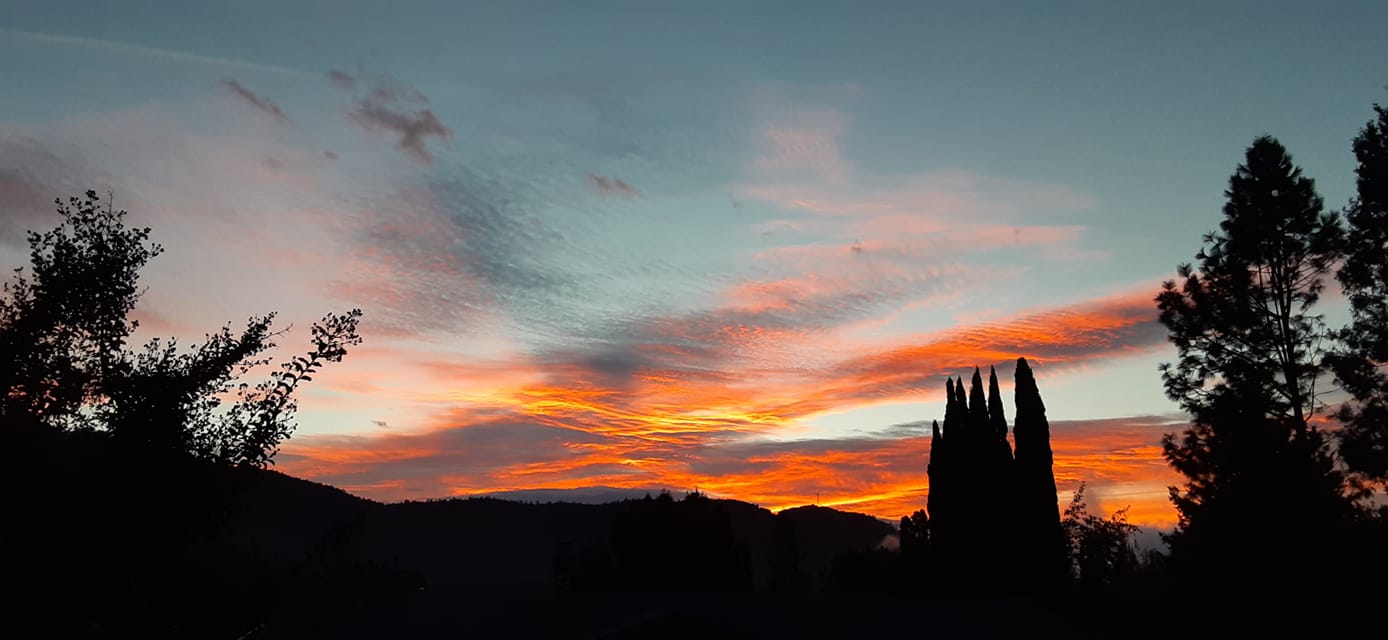
And I've watched sunrises out my office window as I've sipped my coffee...and sunsets as we've sat on our front deck enjoying the end of the day that rival the masterpieces of Monet and Rembrandt. Truly stunning compositions of light and shade and wonder. Witnesses to God's easel and to his brushstrokes.


Ms. Parker's quote reminds me of the one absolute prerequisite for me to enjoy any of these wonders. It is to stop and to look up. To get out of my head and the world of thought. To lift myself out of the well-worn ruts of "habit", "what I gotta do", and "comfort", and work a little bit to feel something...and to be open.

To feel and to be open sound like such inviting things, yet there's something inside of me that shies away from doing so. Something that prefers the smaller world of "the known" where it sits on its throne regally declaring, "Been there. Seen that. Love that. Don't like that." And then sits back surveying what it believes is a vast kingdom that it reigns over.

But that nature is in truth a sad, little coward. An "Emperor without Clothes", tricked into believing that Life has limits and that these limits should never be disturbed.

It takes effort to break free from the inner empire of inertia. Don't I know it. I have experienced it 100's of times in these very pages. But the effort is ALWAYS rewarded. Always. And the rewards are always greater than anything I could've even imagined back in the world of "Don't Try".

Glad to take a first step this morning in a new direction. Let's see what there is to see.


Some simple beauty...one leaf...quietly waiting in the morning rain for me to discover...Ahh. Glad I looked up.

Wednesday, November 7, 2018

Precious Pearls - Quotes That Have Inspired Me (#5)

Life...once again...took me away from these pages. New jobs...old habits...Responsibilities, new and old...time spent trying to figure out my golf swing, rather than contemplating higher things. The death of my father this summer and days of endless smoke from forest fires all around us also dimmed my writing spirit. Yet here I am again. Grateful that the ember that draws me back here - even after months of neglect - never dies. There can only be one thing that never quits fanning the flame; gently blowing on my heart - "Write. Explore what's inside you". It must be Love.

"It is easy in the world to live after the world's opinion; it is easy in solitude to live after our own; but the great man is he who in the midst of the crowd keeps with perfect sweetness the independence of solitude." (Ralph Waldo Emerson)


I shared this Emerson quote recently and this beautiful photo I found. They seemed a perfect fit, for many reasons. 

Fall seems to me the best time to remember the "independence of solitude". All around me I can see Nature in all of its forms - tall and tiny - letting go, freeing itself of all that had accumulated. Maples, aspens, and oaks all celebrate their new independence with explosions of color, freely given to the winds to strew wherever they wish. There is no sadness in their sacrifice. In fact, I would argue the trees are as beautiful as they ever will be, even as parts of them are dying. What a reminder of the power of Love. It transforms all through it's willingness to give all. And therein lies real Freedom.

The photo and quote also remind me of the need we all have for solitude as well. I can imagine myself walking down that quiet lane between the trees: Just the soft swishing of the leaves as my feet sauntered through them. The fog gently muffling the world in cottony, cool, wispy walls. My steps would be slow and measured, because I would want to drink in all of the beauty of a world at peace with itself around me. My mind would naturally quiet. Though alone, I would feel in relationship to every single living thing around me. Nothing demanded of me, yet everything given. But only if I was willing to be alone for a few moments.

Recently Deborah shared this photo and quote with me.


"Truth has a way of simplifying everything. All that isn't love begins to drift away, just like the leaves drifting to ground in fall. Beautiful really." (Deborah DeMattia)

So nice to know that my wife, my best friend, my love, shares the same sense of appreciation for the beauty of fall and knows of the sweetness and freedom found in solitude. Lucky me. Lucky us. 

Friday, March 23, 2018

Precious Pearls - Quotes That Have Inspired Me (#4)

“People are often unreasonable, irrational, and self-centered. Forgive them anyway. If you are kind, people may accuse you of selfish, ulterior motives. Be kind anyway. If you are successful, you will win some unfaithful friends and some genuine enemies. Succeed anyway. If you are honest and sincere people may deceive you. Be honest and sincere anyway. What you spend years creating, others could destroy overnight. Create anyway. If you find serenity and happiness, some may be jealous. Be happy anyway. The good you do today, will often be forgotten. Do good anyway. Give the best you have, and it will never be enough. Give your best anyway. In the final analysis, it is between you and God. It was never between you and them anyway." (Mother Teresa)


I'm sitting in another teacher's classroom, and there behind me on the wall, was a poster with this beautiful quote from Mother Teresa. I've seen it many times - a source of inspiration on many classroom walls, Facebook pages, Pinterest collections, and Instagram accounts. Its message is one whose goodness and Truth seems universal.

Persist in choosing something Higher, even when everyone and everything around you may be telling you to do the opposite. 

Persist in choosing that which is noble, and compassionate, and Light, even when all seems dark and mean around you.

Persist in forgiving...in choosing hope...in sacrificing for the sake of Love, even when doing so would seem futile or naive.

Because in the end, it isn't about what you will get in return. It isn't about what you achieved. It isn't about what is fair and just. It isn't about "You" at all. The purpose of our lives is fulfilled only when we realize the gift we've been given to be a vessel: an expression of something Divine; of Love.

I can do this in small, individual ways every day. In fact, as I've gotten older, I've grown to realize that it's in those small, seemingly insignificant moments, that small acts of kindness, of quiet sacrifice, of honesty are valued the most. As I read the quote once again, I want to recognize these moments more often, and then remember to act in them. 


“Everyone thinks forgiveness is a lovely idea until he has something to forgive.” (C. S. Lewis)

That wish reminded me of the above quote, and the true cost of such a action. It will always come at a time and place that won't be "easy". Doing the right thing, at the right time, for the right reason rarely is. But it's the only thing I know that rewards both the giver and the receiver. A Divine "deal" that will never disappoint.

Definitely a Precious Pearl to keep in my pocket.

PS:  As I wrote this, I discovered that Mother Teresa never actually said this. The original author of these statements was a Harvard student named Keith M. Keith, who published the original collection of these sayings in a pamphlet titled  “The Silent Revolution: Dynamic Leadership in the Student Council”. Interesting, but makes no matter to me. These principles belonged to neither the saint or the student. They came from a Higher author.


Monday, February 5, 2018

Precious Pearls - Quotes That Have Inspired Me (#3)

"I know in my heart that man is good. That what is right will always eventually triumph. And there's purpose and worth to each and every life." ~ Ronald Reagan


There are some things you read...or hear...or see for the first time, and the beauty and Truth expressed through them just stops you in your tracks. It's as if every fiber in your being just got strummed and you don't want that feeling to go away. It can happen when you see a soothing sunset;  or hear a beautiful song; or read something inspiring.

I have never forgotten the first time I read this quote from President Reagan. It was when Deborah and I first visited the Reagan Presidential Library in Simi Valley, CA twelve years ago. Mr. Reagan has always been a hero of Deborah's, and over time my admiration for him has steadily grown. The quotation is etched on his gravesite on the grounds there.


I pray that I can remember each day the three things the President said with such conviction and optimism here. But I know that it's so easy to be convinced that none of these are true, especially in the divisive times that we currently live. There is a constant drumbeat - especially in the media today - that wants us to believe that
  • Only 1/2 of mankind is "good" - The 1/2 that agree with me.
  • Darkness is destined to carry the day
  • And that few of us will ever have the chance to make a difference
But none of those are true. Life always gives us the choice: to rise or fall; To decide what it is that we really love and will give ourselves to freely. Darkness can never overcome Light.

So  I will do my best today to remember the President's words and look for a little Light in any moment when a little darkness wants to tell me, "There's nothing good here".

What a precious thing to be reminded of....Thank you, Mr. President. Inspiring words like these are few and far between from today's leaders. I guess it's up to others to share something brighter. 


Thursday, January 25, 2018

Precious Pearls - Quotes That Have Inspired Me (#2)

Yesterday's post was so much fun, I had to come back today with another. This quote is truly one of my most favorite.


Dr. King's message about the times in which one's true character and courage are revealed has always inspired me because it seemed to speak to epic moments; to dark, divisive battles that life challenged someone to face. It always seemed to speak of a moment when a "hero" - someone exceptional - was called to rise. And history is filled with those types of stories: special men and women who've stood for something Higher when it was most difficult to do so.

Life asks us: "In this moment - be it comfortable or challenging - Where do you stand? What is your first Love? What will you stand FOR?

And I certainly know that in the most painful and disappointing moments of my life:
  • When my coaching career ended in a storm of parent complaints and accusations
  • When I knew I needed to quit smoking
  • When I've had to admit I hadn't been honest with Deborah and felt her anger and disappointment
  • When family members or friends have hurt or disappointed me
I have felt Life asking me those questions - and I have suffered, or grown, based on my choices.

But as I've gotten older, I've begun to realize that this choice is something Life is ALWAYS presenting to ALL of us - in each and every moment. And it doesn't take an exceptional person to "answer the call". It just takes a willingness to Be Present and to Consciously Choose. So I'm trying to be more aware of this in even the smallest, most routine moments - even those that seem happiest or most comfortable.

What will I stand FOR in this Moment? What do I love? What will I be an expression of? 
  • Will I give my best, even if I don't feel at my best?
  • Will I be honest, even if being so reveals something I don't want to see?
  • When I feel I have every right to be angry, resentful, impatient, etc. will I not inflict it on another?
  • Will I enjoy this moment - with gratitude - and then be willing to let it go?
As I said earlier, a lot will be learned by the choices I make. Writing this has helped me see this quote in a whole new way. 

One more new precious Pearl in my pocket...


Wednesday, January 24, 2018

Precious Pearls - Quotes That Have Inspired Me (#1)

I've been trying to come up with an idea for some new, shorter blog entries so I'll be tempted to write more often. This will be my first attempt. I've always collected quotes throughout my life: posted them on my wall in my classrooms, shared them with friends, etc. So in this ongoing series of posts, I'll share a quote that inspired me and a brief reflection on it. I think it'll be fun to see what I choose.

This quote is one I read from Guy Finley's book "The Seeker, The Search, The Sacred". It's a little long, but it is a simple prayer that has always moved me.

A Creed for Those Who Have Suffered (by an unknown Confederate soldier)

"I asked God for strength that I might achieve...
I was made weak that I might learn humbly to obey.
I asked for health that I might do greater things...
I was given infirmity that I might do better things.
I asked for riches that I might be happy...
I was given poverty that I might be wise.
I asked for power that I might have the praise of men...
I was given weakness that I might feel the need of God.
I asked for all things that I might enjoy life...
I was given life that I might enjoy all things.
I got nothing that I asked for...
but everything I had hoped for.
Almost despite myself, my unspoken prayers were answered.
I am among all men most richly blessed."


This prayer reminds me of so many things that I so easily forget, and my mind wants to launch off into some serious intellectual musings about this prayer. But I want to keep this simple. I want to simply remember what I feel each time I read this, because that's why it inspired me.

Humility
Surrender
Connection
Gratitude

And out of all of that, I realize, comes real Strength...and real Peace.

That's a real Pearl worth remembering.


Tuesday, November 18, 2014

Today's Tidbit - The Christmas Truce

"Peace begins with a smile." (Mother Teresa)

About 10 or 12 years ago, I started writing what I called "Today's Tidbits": little anecdotes and often unknown facts from history that I had learned over time that had always amused me. I wrote a couple hundred of them - usually while I was eating my lunch at school and would then send them to friends and family via email.  I really enjoyed them - but stopped when I ran out of topics. When I began writing my blog, I included a few of them in it, but then stopped because I wanted my blog to include more original writings.

This morning a friend sent me a link to a British produced Christmas ad that is going viral.  It reminded me of one of my most favorite tidbits and stories from history, so I decided to share it. The event happened 100 years ago this December. It is such a good reminder of what we as humanity are all capable of remembering, even in the darkest of moments. And it also reminded me of something else more personal.

Here is the link to the ad. It's well worth watching.

"The Christmas Truce of 1914" TV Ad

And here is the Tidbit I wrote to fill in the history of what actually happened.

As Christmas 1914 approached, World War I had been raging across Europe for 4 months - one million men had already died.  In Northern France and Belgium, British and German troops were deeply dug into hundreds of miles of trenches, separated by a bloody "No Man's Land" which would be a killing ground for the next 4 years.  What amazing event occurred on Christmas Eve and Christmas Day of 1914 in this "No Man's Land" where so many had already died, and millions more would die in the future?


Answer:  Christmas Eve and Christmas Day, 1914 saw one of history's most amazing examples of open chivalry and the generosity of the human spirit in what became known as "The Christmas Truce".  On Christmas Eve 1914, British Headquarters sent the following message to all of its units in France and Flanders:  "It is thought possible that the enemy be contemplating an attack during Xmas or New Year.  Special vigilance will be maintained during these periods.".  But no attack came.  Instead, spontaneous, informal truces broke out all up and down the trench-lines, and German and British soldiers who the previous day had been trying desperately to kill each, now joined to celebrate Christmas.  

In most cases, it appears that the German soldiers were the ones who took the lead in making informal contact with the enemy, calling to the British troops to come out and stop shooting.  The Germans had brought Christmas trees into their trenches and decorated them with candles - in some, Chinese lanterns were hung as decorations.  The "rules" of the truce were negotiated by agreement among local officers.  


Christmas Day saw the most fraternization between the two sides.  Groups of 3-4 men on each side would wander out and meet each other in "No Man's Land".  They would laugh and exchange small gifts (cigars, cigarettes, jars of jam, etc.)  In one exchange, when a group of Royal Welsh Fusiliers refused to come out and meet the Germans, the Germans rolled out a keg of beer toward the British trench and said "Here!  We have plenty!".  In return the Fusiliers lobbed tins of bully beef and jam back at the Germans!  One legend of the "Christmas Truce" is that in one spot along the lines, Germans and Scottish soldiers played a soccer match out in "No Man's Land", just outside of Armentieres.  A German officer in the 133rd Royal Saxon Regiment describes such a game, following a gift exchange between the two sides (cigarettes, schnapps, chocolate).  The game was played with great enthusiasm (though not a lot of skill!).  The officer says the Germans howled with laughter when a gust of wind blew the Scots' kilts up - and revealed they weren't wearing any underwear!  According to the officer, the game ended after an hour: the Germans won, 3-2.  


As night fell on Christmas Day, the truces slowly ended and the men returned to their trenches.  Soldiers on both sides sang Christmas carols in the night - sometimes the haunting sound of "Silent Night" could be heard at the same time as "Heilige Nacht" echoed from the other side.  At 8:30 pm, a British officer stood on top of his trench and fired 3 shots into the air.  A German captain appeared on the other side, and saluted.  The next day, the war began again.  By the end of World War I on November 11, 1918, approximately 9-10 million soldiers had died in the long, bloody conflict.


Stories like this remind me of how much I enjoyed teaching history: to both learn and share such stories. The best history teachers I ever knew were great "story-tellers". 

It was that talent of theirs that made history "come alive" and inspired a young man to spend 30 years trying to do the same for his students.


Me at my desk on my last day at school - June 2013

That was me. So here's to remembering all the great history teachers who inspired me, and to all those I had a chance to work with at Glencoe and South Medford High Schools. Cheers!


Thursday, April 7, 2011

Three Powerful Words (and a Tidbit too!)

 "We proceeded on." (Captain William Clark)

Meriwether Lewis and William Clark are two of my most favorite heroes in American history. I have always remembered Clark's phrase above; written at the end of many of his journal entries.  No matter what his fears or the challenges he faced, he often closed by simply saying, "We proceeded on".  In those three words, can be found a great deal of hope and strength - all in remembering to do just that.  "To proceed on" whenever I feel anxious or fearful, stressed or disappointed, alone or lost.

Here's a tidbit I wrote once about these two men and their expedition.

One of the greatest adventures in American history was the 1804-06 expedition of Lewis and Clark to explore and map the American West.  These two men and their Corps of Discovery are recognized as national heroes today for their courage in travelling across 1000's of miles of uncharted wilderness and back.  How many members of the Corps of Discovery died during this journey?  What happened to Lewis and Clark at the end of this journey?


Answer:  Meriwether Lewis and William Clark and the 31 other members of the Corps of Discovery traveled for over two years through the American West; navigating the Missouri and Columbia Rivers; crossing the Great Plains, meeting Indian tribes for the 1st time; suffered through bitter winters there (-45 degrees!) and a dismal, wet winter on the Oregon coast.  But due to Lewis and Clark's leadership and planning, and the discipline of the men they brought along, only 1 man died during the trip (Pretty remarkable!).  Sergeant Charles Floyd died on August 20, 1804, just two months into the trip, from a ruptured appendix.  The rest of the men stayed relatively healthy (venereal disease was the most common affliction!... usually treated with mega-doses of mercury!).  Lewis suffered the most serious injury of the trip.  In August 1806, while nearing the end of their return trip home, Lewis was shot in the buttocks by one of his own men (Pierre Cruzatte) while out deer hunting!  Lewis spent the last month of the return trip to St. Louis lying on his stomach in the bottom of a canoe; the Corps returned home on September 20, 1806.  The men were greeted as long-lost national heroes, but the fame proved fleeting.  In March 1807, Meriwether Lewis was named Governor of Upper Louisiana, the territory he explored.  But he proved to be an uninterested Administrator.  He also became an alcoholic, increasingly depressed with his life.  On the night of October 10, 1809, Lewis committed suicide, alone and penniless, in a Tennessee roadside inn.  The journals he so diligently kept during his trip were by his side, unedited and unpublished.  William Clark enjoyed a more positive life after the journey.  He enjoyed a happy marriage and was elected Governor of Missouri in 1813.  After Lewis' death, he worked to get his friend's Journals published - they finally were 30 years later.  He continued to work to map the West until his death on September 1, 1838.


Sunday, April 3, 2011

Today's Tidbit - The Legend of Face Rock

This is a tidbit I wrote about one of my favorite sights on the Oregon coast.  The sunshine and blue sky today made me remember it, and how much I love the coast!


A striking natural rock formation known as "Face Rock" lies off the Oregon coast near the small town of Bandon.  The largest rock appears to be a human face, gazing up into the sky.  What is the legend/history behind this unique rock?


 Answer:  The origins of the name "Face Rock" come from an old Pacific Northwest Coast Indian legend. The tribes living in the Bandon area were known as either the Coosans or the Athapaskans.  Here is the legend. 

Many, many years ago, Chief Necomah invited Indians far and near to come to the coast and join him in trade and a great feast.  Chief Siskiyou from the far mountains came, bringing along his beautiful daughter, Princess Ewauna.  The feast was truly splendid: the people roasted bear, salmon, elk; huge quantities of clams, mussels were steamed;  honey and huckleberries were the dessert.  

But Necomah warned his visitors from faraway to stay away from the ocean.  An evil spirit, Seatka, lived in the sea, and might cause trouble for the people and their guests. So Necomah placed armed warriors on guard over the high bluffs above the beach, and discouraged the people from going into the water. But Princess Ewauna was enchanted by the sea, never having seen it before.  

One night, while the people were sleeping, Ewauna slipped out of camp and went down to the water, carrying her cat and kittens in a basket and followed by her faithful dog, Komax.  The moon was full and the water glistened in the light.  Ewauna was not afraid of Seatka and began to swim, going farther and farther from shore.  Seatka saw the beautiful princess and rose up to capture her.  

Komax barked a warning - but it was too late. Seatka tried to force Ewauna to look into his eyes, for if she did she would fall under his spell and be his forever.  But she refused to look – staring only at the great, round moon above.  Komax swam bravely out to help his mistress, biting the hand of Seatka.  Enraged, Seatka swung his mighty arm, knocking the dog back to the beach.  He then flung Ewauna's basket of kittens out into the dark waters.  But still she would not look at him.  

The next morning, Chief Siskiyou saw his daughter was missing and sounded the alarm.  The people rushed to the ocean shore.  There they saw the lovely face of Princess Ewauna gazing up to the sky.  On the beach sat Komax, sadly howling at his mistress.  Ewauna's basket, cat, and kittens floated in front of her.  But alas, the evil Seatka had turned them all to stone – his revenge for Ewauna's refusal to love him.  Chief Siskiyou was heart-broken.  He left and never returned.

You can still see Princess Ewauna, Komax, et. al., at the "Face Rock" Viewpoint off Beach Loop Drive in Bandon, Oregon. (it's worth the trip!)


Saturday, March 26, 2011

Today's Tidbit - The Devil's Drink

I had to go out and buy a new coffee maker today - couldn't stand the thought of a Sunday morning without my "cup of Joe", my "Brewtus", my "Go Juice", my mug of Mojo, my "Wakey Juice" - and it reminded me of this tidbit!


 What popular beverage did many medieval Christians believe was "the Devil's drink" until Pope Clement VIII approved its consumption in 1592?


 Answer:  Most of us wouldn't be able to start our day "right" (or get through it!) without a cup or two of this beverage: coffee.  Coffee is the most popular drink in the world today with over 400 billion cups being slurped each year, and the United States is the world's largest consumer of coffee (2.5 million lbs. a year).  But for such a commonly enjoyed drink, we know little about its origins.  

There are many legends about the origins of coffee.  The most common tells of an African goatherd by the name of Kaldi who, in around 600-800 C.E., was tending his animals in modern day Ethiopia when he noticed they were acting quite strangely - jumping around and very hyperactive.  On investigating, he saw they were eating the red berries of a nearby bush.  Curious, Kaldi ate some of the berries and found himself strangely invigorated.  Both man and beast had tasted the power of caffeine!  Kaldi shared his discovery with a monk from a nearby Islamic monastery, who took the new discovery back and experimented by crushing a few berries and then pouring boiling water over them - the first cup of coffee!  The monks grew to like the coffee because it helped them stay awake during their long hours of prayer and the use of it spread to other monasteries.  

Devout Muslims began to believe that coffee was a divine gift brought by an angel from heaven to the faithful on earth, and so the drinking of coffee rapidly spread throughout the Middle East.  Wherever Islam went, coffee went to: from India to North Africa to the eastern Mediterranean.  Arab nations tried to guard the secrets of growing and roasting coffee; it was illegal to sell coffee beans as seeds to non-Arabs.  It's believed that no coffee seed sprouted outside of Africa or Arabia until the 17th century, but it was impossible to stop the demand for the dark, delicious drink.  Coffee became so closely associated with Arabs that during the years of the Crusades many European Christians refused to drink it because it was considered the "wine of the infidels".  When priests in Rome demanded that the drink be banned in 1592, Pope Clement VIII took a sip of it and then declared, "This Satan's drink is so delicious that it would be a pity to let the infidels have exclusive use of it. We shall cheat Satan by baptizing it." 

With the Pope's blessing, the demand for coffee rapidly spread across Europe.  The 1st coffeehouse was opened in Venice, Italy in 1683.  Drinking coffee in England, famous for being the land of tea drinkers, became so popular that there were more coffeehouses in 18th century London than there are today.  But many still thought it to be an evil drink.  In 1674, British women organized "The Women's Petition Against Coffee", complaining that men were spending too much time enjoying themselves at the coffeehouses.  Prussia's Frederick the Great tried to block the imports of coffee to his country in 1775.  He thought coffee was "disgusting" and encouraged his subjects to drink beer instead - he even employed "coffee smellers" to stalk the streets sniffing for the aroma of the outlawed drink.  Tea was the favorite beverage in the American colonies until the British raised the tax on it, leading Americans to switch to coffee in protest (and to ultimately revolt!).  

The Dutch became the people most responsible for spreading coffee around the world and Amsterdam became the coffee capital of the world.  But the Brazilians were the slyest.  In 1727, Brazil's emperor decided that he wanted a cut of the coffee market so he sent an aide of his, Lt. Colonel Francisco de Melo Palheta, to French Guiana to settle a border dispute between the French and Dutch - and to steal some coffee seedlings.  Palheta not only settled the dispute, but also had the "energy" to initiate a passionate affair with the wife of the French governor!  She was so enamored with Francisco that, as a farewell gift, she gave him a bouquet of flowers in which she had hidden some coffee seeds and cuttings.  It is from these "love shoots" that the world's greatest producer was born.  Brazil's huge coffee plantations soon turned coffee from a drink only for the rich elite to an everyday drink that any "common Joe" could afford.  And finally, if you think you're a coffee addict, you couldn't be as bad as the French philosopher Voltaire (1694-1778). It's reported that he drank 50 cups a day!


Friday, March 25, 2011

Today's Tidbit - The "Surprise" Party

Any time I need a laugh, I always remember this tidbit!


During the Presidential election of 1940, the two chief candidates were Franklin D. Roosevelt, the Democratic incumbent, and Wendell Wilkie, his Republican challenger.  However, in the spring of 1940 a 3rd party candidate for the "Surprise Party" successfully stole the limelight from these two men and was enormously popular.  Who was the candidate for the "Surprise Party" and why were they so popular?


 Answer:  This popular Presidential candidate was none other than Gracie Allen, comedienne and wife of George Burns.  What began as a simple radio gimmick and skit took on a life of its own during the spring of 1940 - primarily because you never knew what Gracie would say next.  When asked why her party was named the "Surprise Party", she said "My mother was a Democrat, my father a Republican, and I was born a surprise."  She would pop up on all of the popular radio programs to offer her views on the burning issues of the day.  Gracie on wildlife conservation? - she said she would close all nightclubs by 10 pm.  On whether she would recognize the Soviet Union - "Well, I don't know, I meet so many people!"... On the Neutrality Bill? - "If we owe it, let's pay it."... Her party's mascot was a kangaroo named Laura (1940 was a leap year)... Party slogan:  "It's in the bag".  On May 17, 1940, the Surprise Party held its nominating convention in Omaha , Nebraska - thousands of wildly enthusiastic delegates attended and unanimously nominated her for President.  She had no vice-Presidential candidate however - Gracie warned that she "...had no toleration for vice in her Administration!".  Alas, on Election Day, FDR was reelected with 27 million votes; Wilkie finished 2nd with 22 million;  Gracie garnered only a few thousand, mostly from Oklahoma and Nebraska.  Still, the nation had had fun.  Gracie later said she was glad she had lost.  "I realized that the President of today is merely the postage stamp of tomorrow."... (Don't you wish politics were still this innocent and fun?).


Thursday, March 24, 2011

Today's Tidbit - Harry Houdini and WWI

Happy 137th birthday to Harry Houdini! (and 51st birthday to my sister Molly - magically, she never seems to look any older!)


Most would agree that the world's most famous magician and escape artist was Erik Weisz, or better known as Harry Houdini.  He was a master of outdoor spectacles and life-threatening magic and took his stage name from Robert Houdin, a French magician he idolized when he was a boy.  By the time he was 26, he was world famous and known as "The Escape King".  During World War I, the U.S. Army hired Houdini for an unusual task.  What did they hire him to do for them?


Answer:  Houdini was a great innovator and performer.  He literally invented the "challenge escape act", in which at various times he escaped or got out of any and all of the following: handcuffs, leg irons, straitjackets, jail cells, giant paper bags (without tearing the bag), iron boilers, a giant football, a sealed milk can, and the infamous "Chinese Water Torture Cell". In some of his escapes he was often hung upside down 100's of feet in the air and in plain sight of his audience.  Because of his talent, the U.S. Army hired Houdini in 1917 to train American troops on how to escape from handcuffs! (no report on whether any ever used the skill).  Houdini continued to perform brilliantly until 1926.  On October 26th, while resting before a performance he was "sucker-punched" in the stomach by a young college student.  Houdini died 5 days later in a Detroit hospital from a ruptured appendix (He did not die in a failed escape, as Hollywood would have us believe).  He is still known today as one of the greatest performers of the 20th century.

Wednesday, March 23, 2011

Today's Tidbit - America's Shortest War

Here's hoping our latest military action is a short one...they never seem to turn out that way...


What was the shortest war ever fought by the United States and who was it against?


 Answer:  The shortest war fought by the United States took place in 1867, and lasted only one day!... And the "enemy" was a self-styled "independent" republic in eastern Texas, which called itself the Free State of Van Zandt...  (tell me more!)...It seems the citizens of Van Zandt county would not accept Federal military rule after the Civil War, so they voted to secede (since that had worked so well for the Confederacy!).  U.S. General Philip Sheridan in New Orleans, when he heard the news, sent a cavalry unit to put down the rebellion.  The citizens of Van Zandt, when they heard the news, declared war vs. the United States, and then rushed to the county line with shotguns and rifles, and ambushed the cavalry unit!  The cavalrymen, who were expecting a casual ride into the country, retreated - mostly in surprise.  The Van Zandters, jubilant at their "victory", raised a mighty "Huzzah" - and then retreated to a tavern at Canton, Texas to celebrate...(And did they ever celebrate!).  The now more serious U.S. Cavalry unit returned that night, marching unopposed all of the way to Canton - to find the now less serious (and very drunk!) "victors".  The 100 or so rebels were arrested and put into a crude stockade.  But after 2 nights as captives, all of them were able to escape out of the stockade - and fled into western Louisiana - where they were never caught!  No one was ever arrested or tried for treason - the affair was quickly forgotten.  Except in Texas - today you can still see a sign on the highway leading into Canton, which reads: YOU ARE ENTERING THE FREE STATE OF VAN ZANDT.


Tuesday, March 22, 2011

Today's Tidbit - Pearls Learned From History

I began writing these 10 years ago.  Thought I'd start putting them on my blog.  Hope you enjoy them (and maybe even learn a thing or two!)

One of the world's most widely recognized foods is pizza.  Who invented it?  Where did the odd name for this popular dish, now eaten around the world, come from?


Answer:  It's not possible to identify a single person or culture as the "inventor" of pizza, though this dish most certainly originated among the cultures of the Mediterranean Sea.  Historical records show that the ancient Greeks ate flat, baked bread that they topped with olive oil, garlic, onion, and spices called "plakuntos".  Romans also ate a similar dish, but called it "placenta".  The modern word pizza is derived also from the Romans - the Latin word "picea" was used to describe the black, burned crust of the "placenta" as a result of its being baked in an oven.  And the ancient Egyptians also ate a flat bread seasoned with herbs to celebrate the Pharaoh's birthday each year.  But pizza as we know it today was first created in Naples, Italy during the Renaissance.  It was originally considered to be "peasant food" - a simple and tasty food that the poor could make from the limited supplies they had available: flour, lard, olive oil, cheese, and local herbs.  Tomatoes were not used on early pizzas because they weren't introduced to Europe until the 16th century, and were originally considered to be poisonous!  Gradually over time, southern Europeans overcame their superstitions and the use of tomato sauce became more widespread.  By the end of the 18th century, Naples had gained the reputation of having Italy's finest pizza.  Street vendors selling small pizzas (typically young boys) walked around the city with small tin stoves on their heads, calling out to attract customers for their freshly baked pies. (Talk about "hotheads"!)  The world's first true pizzeria was "Antica Pizzeria Port'Alba", which opened in 1830, and is still in business today.  (Now called "Via Port ‘Alba 18").  If there's any one man most responsible for what we know as pizza today it was an Italian chef, Raffeale Esposito of Naples.  In 1889, he baked a special pizza to honor the visit of King Umberto and Queen Margherita to his city.  To make the pizza more patriotic-looking, Esposito used red tomato sauce, white mozzarella cheese, and green basil leaves as his toppings to match the colors on the Italian flag.  The Queen loved the pizza, and Esposito's version soon became known as "Pizza Margherita", and is the model for most pizzas we eat today.  Pizza came to the United States at the end of the 19th century with the waves of Italian immigrants.  The first true pizzeria in the U.S. opened in 1905: "Lombardi's" at Spring Street in New York City (also still in business today).  But it wasn't until after World War II that pizza became a "national dish" for Americans - spurred by American GIs returning home from the war in Europe and wanting to eat the pizza they'd loved while in Italy. In the last 50 years pizza has become a part of almost all cuisines, though often topped with unusual ingredients (you can buy a "reindeer sausage" pizza in Iceland!).  February 9th is "International Pizza Pie" Day.  Americans eat an average of 23 pounds of pizza each per year, with pepperoni pizza being the clear favorite.  And in Naples, the "pizza capital of the world", the Association of True Neapolitan Pizza" ("Associazione Verace Pizza Napoletana") maintains strict regulations insuring that pizza there is still made in the same way it was 100 years ago.